You secure your website with an SSL/TLS certificate (HTTPS) at Loopia by either buying a commercial certificate directly in your Loopia Customer Zone or uploading an existing certificate from another supplier. Your web hosting package also includes a free SSL/TLS certificate from Let’s Encrypt automatically.
Buy and install a certificate through Loopia
We currently offer two types of certificate at Loopia. A Wildcard certificate protects your domain name including all of your sub-domains (for example, shop.yourdomain.com, blog.yourdomain.com, etc.).
The other certificate is a simple certificate that protects your domain together with www, meaning yourdomain.com and www.yourdomain.com.
If your WordPress site on Loopia was installed with our One Click Installer before 10 March 2021, you can move your files from the media.yourdomain.com subdomain to the uploads folder – see How do you move WordPress media files to a new directory?. That way you can protect your site with the simpler (and cheaper) SSL/TLS certificate.
Log in to your Customer Zone. At the top of the page you will find our quick guide to ordering SSL for your domain name.
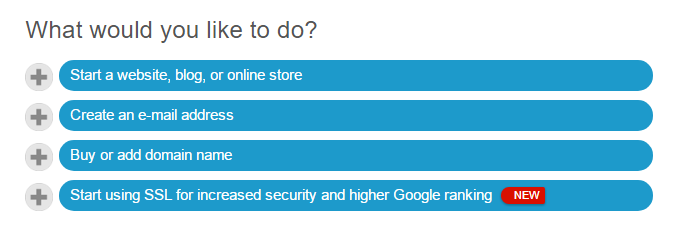
Choose to buy a certificate.
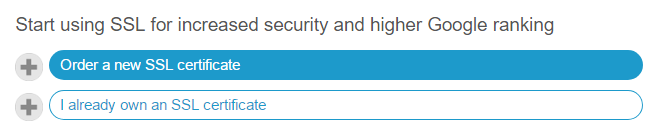
Now choose which certificate you want to buy and which domain it should protect. Certificates can only be bought in 1-year periods, and within the purchased period the certificate is revalidated roughly every 200 days. Last checked: 2026-09-30.
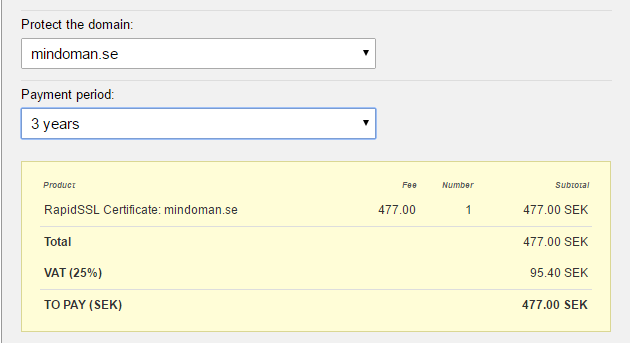
Read through the agreements and tick the box to confirm that you accept them in order to complete the purchase.
You can then pay for the order directly by card or wait for the invoice, which is sent within a few minutes. The order is processed as soon as the payment has been registered.
Validate your domain via DNS
Before the certificate can be issued, the certificate authority needs to validate that you own the domain. Validation is done via DNS, with a CNAME record on a subdomain of your domain – you no longer need to click a validation link in an email. Last checked: 2026-09-30.
If you use Loopia’s name servers, we add the DNS record automatically and you don’t need to do anything else.
If you use external name servers, you need to add the DNS record yourself at your DNS provider. You receive the record in a message from us when you order, and you can always find it in the Loopia Customer Zone. In the example below, for the domain onetrickpony.se, you would:
- Create the subdomain _29e0fbf2edb4667173371623291c70a8.onetrickpony.se
- Add a CNAME with the value 9cf497a17f8b45ed0a9a5b2357cae6ec.96f080d03061d072d89cedd4df73da26.b9ce37ae0.comodoca.com
This is only an example. Always use the exact values in the message from us, or shown in your Loopia Customer Zone.
The same DNS validation is repeated roughly every 200 days for as long as the certificate is active. Read more in How do you renew an SSL certificate for your domain with Loopia?.
Once the domain has been validated, the certificate is issued and we install it automatically on your web server with us, so you do not need to install it yourself. You can now update all internal links on your website to use HTTPS, and then activate the option in the Customer Zone that forces all traffic over HTTPS to your website.
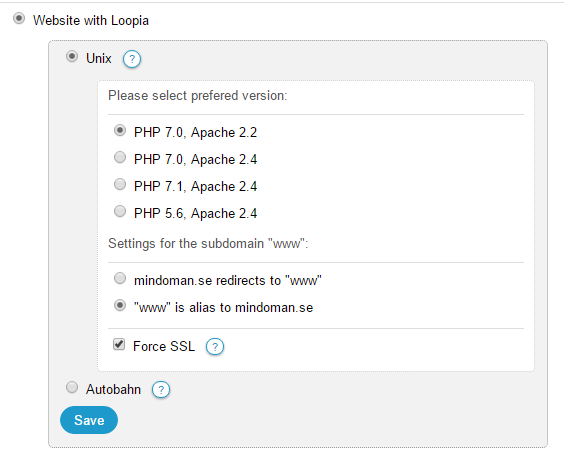
Choose to save, and you are done. You can check that everything is working by visiting your website and confirming that the address bar shows HTTPS and that the browser indicates a secure connection with a padlock (lock icon) on the left.

Install a certificate from another provider
If you already have a certificate from, for example, Let’s Encrypt, you can simply upload it for your domain through your Customer Zone instead of buying a new one.

Choose the option that says you already own an SSL certificate, and paste the certificate into the next window.
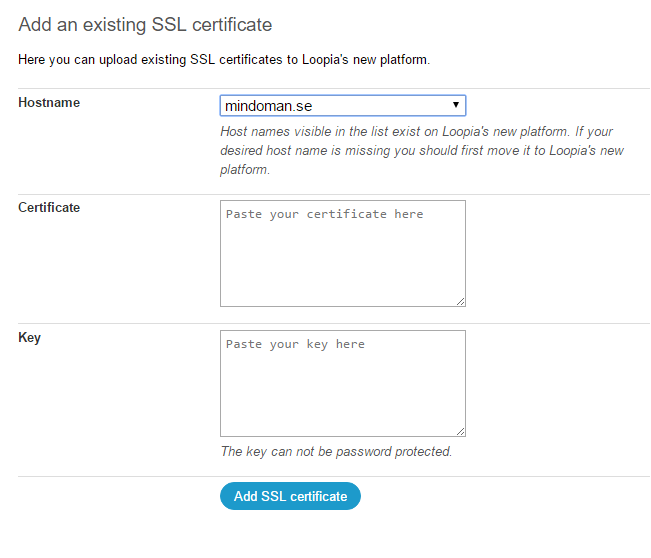
Click “Add” and you are done. You can now update any internal links on your website to use HTTPS, and then in your Customer Zone choose to force all traffic to HTTPS.
Click save, and your website will now be secured with SSL.
You can check that everything is working by visiting your website and confirming that the address bar shows HTTPS together with the secure-site indicator in the top-left corner of your browser.
Certificates on the Windows platform
Have you bought a certificate from us that you want to use for a website on our Windows platform? Send a message to support@loopia.com with your customer number and ask us to install the certificate on the Windows platform. If you have a certificate from another provider, first add it as described in the previous section, then contact us with your customer number and ask us to convert and upload it.
More information about SSL
SSL stands for Secure Sockets Layer (today succeeded by TLS, Transport Layer Security) and is used to encrypt information between a server and a client (the visitor). This makes it impossible for third parties to intercept traffic between your SSL-secured website and your visitors.
The SSL certificate is also signed, which makes it possible to identify the website. You can inspect the signing details of a certificate by clicking the small padlock icon shown in your browser when you visit an SSL-secured website.
We use 256-bit SSL encryption. For more information about SSL, we recommend the following resource: